
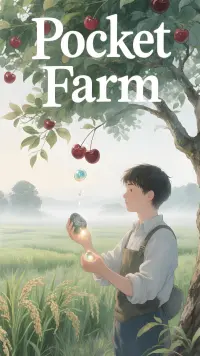
Pocket Farming
The Liu family home sat atop the western edge of Shangliang Village, nestled halfway up the slopes of Little Green Mountain—a spur of the verdant Qing Mountain range. The nearest neighbor was still over four hundred meters away, giving the house a secluded, peaceful feel.
From the foot of the mountain, the Liu home was partially hidden among trees, its tiled roof and upturned eaves just visible through the foliage—a classic rural scene.
At the center of the front courtyard stood two massive osmanthus trees, their branches forming a natural canopy that shaded the entire yard. In September, when the flowers bloomed, the fragrance would permeate the entire mountainside.
To the right of the house, grapevines climbed a trellis, creating a lush green awning covering nearly an eighth of an acre. Hidden among the leaves, clusters of unripe green grapes dangled, making one’s mouth water in anticipation.
The left side of the courtyard was a vegetable garden, planted with familiar produce—tomatoes, cucumbers, eggplants, loofahs—a typical farmhouse garden.
In one corner stood an old-fashioned hand-pump well, flanked by several large flagstones where the family washed vegetables and clothes.
This was the place where Liu Rui had grown up—and where he might one day raise a family of his own.
"Dad, didn’t I tell you not to overdo it?" Liu Rui scolded gently as he saw his father sitting on a chair, weaving a bamboo chair.
"It’s fine—I’m not completely useless yet!" Despite his shattered legs, Liu Jiahong’s spirit remained unbroken, his voice as robust as ever.
Sighing, Liu Rui said no more. After all, it was good that his father had something to occupy himself with—idleness would only slow his recovery.
Shangliang Village, backed by Little Green Mountain, was surrounded by a vast bamboo forest spanning several kilometers. The villagers, living off the land, had long mastered the art of bamboo craftsmanship. Nearly every household in Shangliang made bamboo products—chairs, baskets, winnowing fans—which were highly sought after in Qing County. It was one of their primary means of supplementing their income.
Though bedridden, Liu Jiahong couldn’t stand idleness. So Liu Rui would chop bamboo from the mountains, split it into strips, and bring it back for his father to weave while seated.
"Big brother, you’re back!" A girl’s voice rang out as Liu Rui parked his bicycle against the wall. "Uncle Li from Xialiang Village just sent word—he wants fifty pounds of rice wine tonight." young girl darted out of the main hall, chattering away. "And Liu Zhi ran off fishing again instead of studying!"
She had two braids, wore shorts and a white T-shirt, and her bright eyes sparkled with mischief.
This was Liu Zhi’s twin sister, Liu Tongtong—born just fifteen minutes after him, which was why she resented having to call him "big brother."
"Little traitor!" Liu Zhi muttered under his breath as he placed a bucket by the well.
"Hey, you’re supposed to call him second brother!" Liu Rui ruffled her hair. "Both of you, go study in the study room. School starts next week—you can’t keep slacking off."
Liu Tongtong stuck out her tongue at Liu Zhi before running inside. Liu Zhi hesitated, but a glare from Liu Rui sent him scurrying off as well.
Liu Rui glanced at the old wall clock in the hall—it was already past four. He still had deliveries to make, but first, he needed to clean the blackfish Liu Zhi had caught.
He scooped the fish from the bucket—it was a hefty one, easily over two pounds, a rare catch indeed.
Blackfish, also known as Channa argus, were carnivorous freshwater predators common in lakes and rivers. With their high protein content and lack of fine bones, they were a delicacy enjoyed by all ages, often called "the gem of freshwater fish." Rich in nutrients and flavor, they were prized as a tonic for the sick and frail.
The fish’s slimy scales made it tricky to handle, but Liu Rui, raised by the Xiao River, had no trouble with it.
But as he gutted the fish, something unusual caught his eye—a small, round, hard object inside its belly.
Folklore said killing a cow or dog could yield a gallbladder or "dog pearl." Could this be something special?
Lost in thought, Liu Rui didn’t notice the fish wriggling free—until its sharp fins slashed his right index finger, blood spurting out.
"Damn it!" he cursed inwardly.
Grimacing through the pain, he finished cleaning the fish and washed the strange bead clean.
About the size of a glass marble, it resembled marble in texture, with intricate carvings of flowers, insects, and birds—an antique-looking trinket with a rustic charm.
Holding it up to the sunlight, Liu Rui saw nothing remarkable—just a cool, pleasant feel.
Noticing a small indentation on the bead, he fetched a red silk thread from inside the house and strung it around his neck like a pendant.
What he didn’t realize was that his blood, which had dripped onto the bead, had silently seeped into it.
After finishing with the fish, Liu Rui heard the pigs in the pen squealing hungrily. Checking the time, he mixed their feed and headed out to feed them.
Brewing wine brought steady income to the Liu family, but their most profitable venture was pig farming.
The fermented mash left over from distillation—rich in protein and vitamin B—was perfect livestock feed. It aided digestion, boosted appetite, and promoted weight gain. Pigs fed on mash grew faster and leaner. The Liu family’s distillery produced twenty to thirty two-hundred-pound pigs annually, providing a reliable source of income.
This, along with the distillery itself, was why the Liu family lived comfortably.
In Liu Rui’s childhood, the family would slaughter a pig every New Year, hanging sausages and cured meats under the eaves—a sight that drew envy from neighbors. But in recent years, with rising school expenses, they’d cut back, with the last slaughter four years ago.
Now, the pen held six pigs, each weighing over a hundred pounds. They’d be ready for market in a month—a crucial source of debt repayment.
Watching the pigs jostle for food, Liu Rui felt a surge of satisfaction. Six pigs meant at least twelve hundred pounds—three thousand yuan at current prices, enough to chip away at their debts.
Earlier, he’d sold three thousand yuan worth of rice. Add the pigs, plus the lychees ripening in the orchard on the back mountain, and the family could easily clear ten thousand yuan this summer.
Running the numbers in his head, Liu Rui concluded that his parents hadn’t left him a hopeless mess. This family, for all its struggles, was still worth fighting for.
 Font
Font Background
 Contents
 Home
Home